Global scenario and implications for Latam
The global scenario remains positive for Latam. Regarding US growth, GDP expectations have been revised upward and above potential, supported by fiscal stimulus effects on consumption and investment, the transmission of last year’s interest rate cuts, continued AI‑related capex, and stronger productivity expectations. As a result, the economy continues to avoid recession despite pressures from higher tariffs.
The labor market remains crucial to this outlook. Job creation was revised downward for last year and is expected to remain limited in the first half of 2026. Immigration restrictions and demographic shifts are constraining labor supply, while AI‑related adjustments have softened labor demand. At the same time, fiscal stimulus, lower interest rates, and AI‑driven investment are keeping layoff rates low, suggesting a new equilibrium of both lower hiring and lower firing.
The second key factor is inflation, which is likely to remain above target in 2026. In the first half of the year, inflation pressures will persist due to tariff pass-through, but headline inflation is likely to gradually ease in the second half as other disinflationary forces—such as softer housing prices and slower wage growth—take hold, reducing the risk of a wage‑driven rebound.
In this context, the Fed is expected to maintain a cautious and data‑dependent approach. Additional rate cuts may only materialize in the second half of 2026. This stance appears largely independent of the new Fed Chair nominated by President Trump, Kevin Warsh, given that most of the FOMC is unlikely to support further cuts if the labor market remains contained, growth stays positive, and inflation remains above target. Overall, a scenario where the Fed still has room to cut rates is positive for emerging markets.
For Latam, despite higher tariffs, trade patterns remain stable and growth resilient. The most positive development for the region is on inflation and monetary policy: with inflation decelerating and currencies appreciating against a weaker dollar, tariff announcements may turn out to be disinflationary, giving central banks more room to cut rates. Finally, even with limited tariff impact and prospects of lower rates, upcoming local elections could increase volatility in the region, especially amid elevated geopolitical risks.
Brazil
Economic Activity
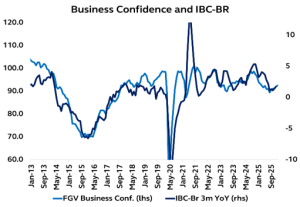
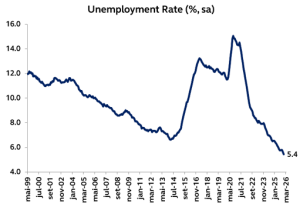
On the economic front, attention remains focused on the pace of the slowdown in activity, which still shows signs of resilience. The IBC-Br index rose 0.7% month-over-month in November, following two consecutive months of modest declines. This acceleration is not enough to materially change expectations for 2025 growth, but it still suggests a gradual deceleration process in the economy. In addition, the labor market remains resilient, with the unemployment rate once again surprising market expectations to the downside, renewing historical lows and reinforcing the view of a still very tight labor market.
Source: IBGE, FGV and Principal Asset Management
Source: IBGE, FGV and Principal Asset Management
Inflation and Monetary Policy
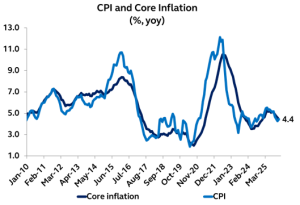
On the inflation front, signals remain favorable in the short term. The January IPCA-15 rose 0.20% month-over-month, slightly below market expectations. On an annual basis, inflation remains on a moderating path, staying below 4.5%. More importantly, with a more favorable risk balance for current inflation, expectations have continued to decline. The median projection for 2026 has fallen from 4.5% in the first half of last year to 4.0% in January.
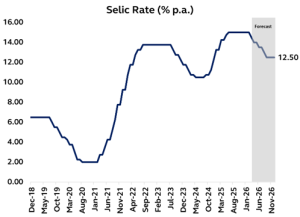
This set of factors strengthens the debate around the beginning of the easing cycle. At its latest meeting, the Central Bank kept the policy rate unchanged at 15% but introduced changes to the statement that suggest increasing proximity to the start of rate cuts. In the minutes, the Central Bank highlighted greater confidence in the disinflation process and a smaller gap between inflation expectations and the target. Despite ongoing concerns about labor market strength, the monetary authority emphasized that the current stage of monetary policy allows for a strategy focused on calibrating the level of interest rates, starting at the next meeting. In this context, we believe that the change in the Central Bank’s stance, combined with a benign inflation environment, allows the Central Bank to begin the easing process with a 50bps rate cut at the next meeting in March.
Source: IBGE and Principal Asset Management
Source: IBGE and Principal Asset Management
Fiscal accounts and political scenario
On the fiscal front, the 2025 fiscal deficit ended the year within the target set by the fiscal framework. However, attention is shifting to 2026, an election year in which additional fiscal stimulus measures may be deployed. Moreover, medium-term challenges to fiscal sustainability further underscore the importance of the electoral debate and the definition of a more sustainable economic policy over the longer term.
On the political front, attention is increasingly turning to the 2026 elections. Although still relatively distant, the potential for a change in power is making the topic progressively more relevant for markets. On the government side, the overall assessment of the current administration remains negative. Approval ratings continue to stand at historically low levels for the Lula administration, and a more favorable economic backdrop — with moderating inflation and a strong labor market — has not yet proven sufficient to reverse this trend.
On the other hand, the right-wing bloc remains fragmented and without clear leadership. Flávio Bolsonaro’s candidacy has gained traction following recent improvements in polling, keeping him as a relevant contender for the presidential election and reinforcing uncertainty regarding the electoral outcome. This does not necessarily rule out the possibility of a change in power, but it reinforces the view of a more turbulent path toward the election outcome.
Chile
Economic Activity
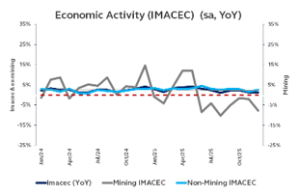
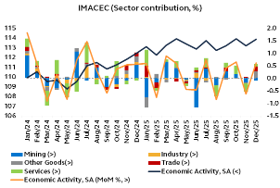
Economic activity closed the year on a stronger-than-expected note, with annual growth of 1,7%, consistent with GDP expanding by roughly 2,3% in 2025. In seasonally adjusted terms, December surprised to the upside with a solid 0.6% monthly increase, driven mainly by retail, while partially offset by weaker mining performance. By year-end, non-mining activity had expanded by 3,0%.
That said, data volatility remains elevated. Activity prints continue to be influenced by swings in copper prices, shifting consumption patterns linked to retail promotions (Cyber and Black events), and changing expectations. Even so, this marks a second consecutive year in which growth has stabilized at, or slightly above, the economy’s potential, with inflation near target and the policy rate close to neutral. In broad terms, most pandemic-related imbalances appear to have normalized, although fiscal and labor dynamics continue to lag.
Looking ahead to 2026, growth is projected around 2,5%, supported by investment, mining, and commerce, alongside still-constructive sentiment among consumers and firms. The main risks to this outlook remain the external environment and the possibility that expectations surrounding the incoming government prove overly optimistic.
Source: Central Bank of Chile
Source: Central Bank of Chile
Inflation and Monetary Policy
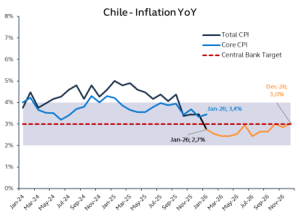
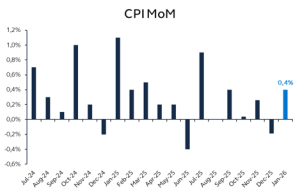
January’s inflation print showed a 0,4% monthly increase in prices, aligned with market expectations, with the twelve-month gouge dropping to 2,8%. 10 out of the thirteen different categories felt an increase in prices, led by health care, tobacco and alcohol, while transportation led de decline in prices during the month with lower fuel and airfare prices, in a context where the CLP appreciation over the last couple of months has contained the price of tradable goods.
Core CPI on the other hand, had a 0,7% increase during the month, reflecting a more persistent trend in the local components of inflation, mainly in services. Nevertheless, it remains below the 3% threshold on a twelve-month basis and is consistent with the Central Banks inflation convergence process.
Overall, the January inflation release confirms that the disinflation process remains well contained. This backdrop continues to support expectations of an additional monetary policy rate cut in the coming months, allowing the policy rate to converge toward its neutral level in the near term.
At its January meeting, the Central Bank delivered no major surprises, keeping the policy rate unchanged at 4,5% and maintaining a cautious, data-dependent stance. Nonetheless, the Board highlighted that the external environment has become more supportive for the Chilean economy, reflecting stronger US growth and elevated copper prices, even as global risks remain materially present.
Source: Instituto Nacional de Estadísticas (INE)
Source: Instituto Nacional de Estadísticas (INE)
Fiscal accounts and political scenario
Recent fiscal figures have disappointed, with the effective deficit reaching -2,8% in 2025 and marking the third consecutive miss of the official target. In response, the Autonomous Fiscal Council (CFA) estimates that an additional US$822 million in adjustments will be required to balance this year’s budget, on top of the consolidation already announced by the incoming administration. Public debt, meanwhile, stabilized at 41,7% of GDP, its first pause in more than two decades, although this largely reflects the recent appreciation of the Chilean peso. Looking ahead, debt is expected to rise modestly by around 0,7 percentage points of GDP in 2026.
Against this backdrop, the political environment appears somewhat more stable ahead of the new government’s inauguration. However, fiscal accounts will remain under scrutiny, particularly as the proposed tax reform (approximately US$3,5 billion) moves forward. The initiative seeks to gradually reduce the corporate tax rate from 27% toward a longer-term objective of 20%, at a time when tax revenues have softened while fiscal spending remains elevated.
Mexico
Economic Activity
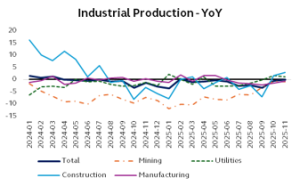
Activity strengthened at the end of the year, confirming the incipient recovery we anticipated. The 4Q25 flash GDP rose 1.6% YoY (from -0.3% in 3Q25), comfortably beating expectations and bringing full-year growth to 0.7%. The quarterly expansion was driven by a rebound in industry and resilient services, both advancing 0.9% QoQ, while agriculture contracted sharply after leading growth earlier in the year. Construction likely remained the key driver within industry, consistent with solid gains observed during the first months of the quarter and supported by both public infrastructure execution and improving private investment dynamics.
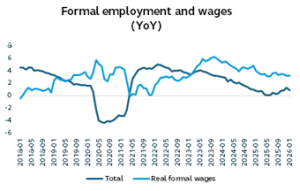
The improvement in activity also provides a favorable starting point for 2026 as well as favorable base effects. Domestic demand fundamentals remain broadly supportive: consumption continues to be underpinned by firm wage dynamics and stable employment conditions, while investment shows early signs of reacceleration. Together with resilient exports, the stronger closing momentum in 2025 suggests a moderate but more balanced recovery through 2026.
Source: INEGI and IMSS
Source: INEGI and IMSS
Inflation and Monetary Policy
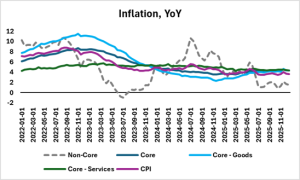
Mexico’s inflation data at the start of the year delivered mixed but manageable signals. The bi-weekly print for the second half of January surprised to the downside, with headline CPI rising 0.17%, mainly reflecting sharp declines in agricultural prices—particularly fruits and vegetables. However, underlying pressures remain persistent: core inflation increased 0.30% in the period and accelerated to 4.56% YoY, while headline inflation edged up to 3.82% YoY. Goods inflation continued to absorb the pass-through from excise taxes and showed early signs of tariff-related pressures in some categories, whereas services behaved broadly as expected despite some dispersion across components. The favorable contribution from non-core items partially offset the stickier core dynamics, reinforcing the view that disinflation will remain gradual and uneven.
Looking ahead, the inflation path remains conditioned by tax adjustments and potential tariff effects. As in 2025, agricultural prices are providing temporary relief, but the trajectory of goods inflation will depend on the magnitude of import price pressures, while services inflation should remain relatively firm amid wage growth. Our baseline still assumes headline inflation near 4% by end-2026, with core inflation above target, implying only gradual convergence and keeping risks tilted to the upside.
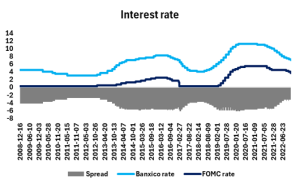
From a policy standpoint, Banxico kept the policy rate unchanged at 7.0%, adopting a near-neutral tone. The Board revised inflation projections upward and postponed convergence to target toward 2027, suggesting greater caution despite leaving the door open for further easing. We continue to expect the easing cycle to resume later in the year, with two 25bp cuts toward a 6.50% terminal rate, although the timing remains data-dependent and downside risks dominating, as stated in the Central Bank 2026 Monetary Program. In this context, upcoming inflation prints will be key, particularly regarding the extent of tariff pass-through and the persistence of core pressures, which will ultimately determine whether cuts begin around mid-year or somewhat earlier.
Source: INEGI and Banxico
Source: INEGI and Banxico
Fiscal policy and political scenario
Public finances closed the year on a stronger footing than anticipated, reinforcing the consolidation narrative while preserving fiscal flexibility. The budgetary deficit declined to 3.9% of GDP in 2025 (from 5.0% in 2024), and the primary balance moved close to equilibrium at -0.2% of GDP, signaling improved debt dynamics. The broadest measure (PSBRs) narrowed to 4.8% of GDP (from 5.8% in 2025), while the Historical Balance stabilized near 53% of GDP, slightly higher than our estimate, but consistent with a sustainable trajectory.
The adjustment was supported by robust tax revenue performance—rising 4.1% YoY in real terms and exceeding the fiscal program—which more than offset lower oil revenues. Greater transparency around Pemex-related support and one-off revenues also improved the readability of the underlying fiscal stance.
Looking ahead, fiscal credibility remains solid, but the policy focus is gradually shifting from consolidation toward the composition of spending. Authorities appear increasingly inclined to expand public investment while keeping the deficit broadly contained, likely through resource reallocation and off-budget mechanisms. This preserves space for capital expenditure to support activity amid still-moderate private investment, while maintaining macro stability. On the external and political front, our base case remains that an agreement preserving the core of USMCA will be reached, though uncertainty and episodic volatility around negotiations are likely to persist.
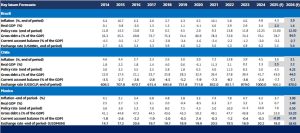
Key Latam Forecasts
AUTORES:
Carlos Bautista – Sr. Research Manager LATAM
Marcela Heilbuth Pereira Rocha – Chief Economist – Brazil at Principal Asset Management
Ramiro Torres – Research & Quantitative Analysis Assistant Manager
This material covers general information only and does not take account of any investor’s investment objectives or financial situation and should not be construed as specific investment advice, a recommendation, or be relied on in any way as a guarantee, promise, forecast or prediction of future events regarding an investment or the markets in general. This report has been prepared for informational purposes only. It is neither intended, nor should be considered, as an offer, solicitation or recommendation to buy or sell shares of any investment fund managed or sponsored by any entity of Principal Asset Management Ltda. nor should it be construed as such in any jurisdiction where such offer, solicitation or recommendation would be illegal. This presentation is not intended to be, nor should be considered, a basis for any contract for sale or purchase of any security, loan or other financial product, or as an official confirmation, or statement of Principal Asset Management. Unless otherwise noted, the information in this document has been derived from sources believed to be accurate as of April 2025. Principal Asset Management is a trade name of Principal Global Investors, LLC, a member of Principal Financial Group. Principal Asset Management Ltda. is a Brazilian asset manager licensed and authorized to carry out its activities in Brazil according to Declaratory Act n. 9.408/07.